
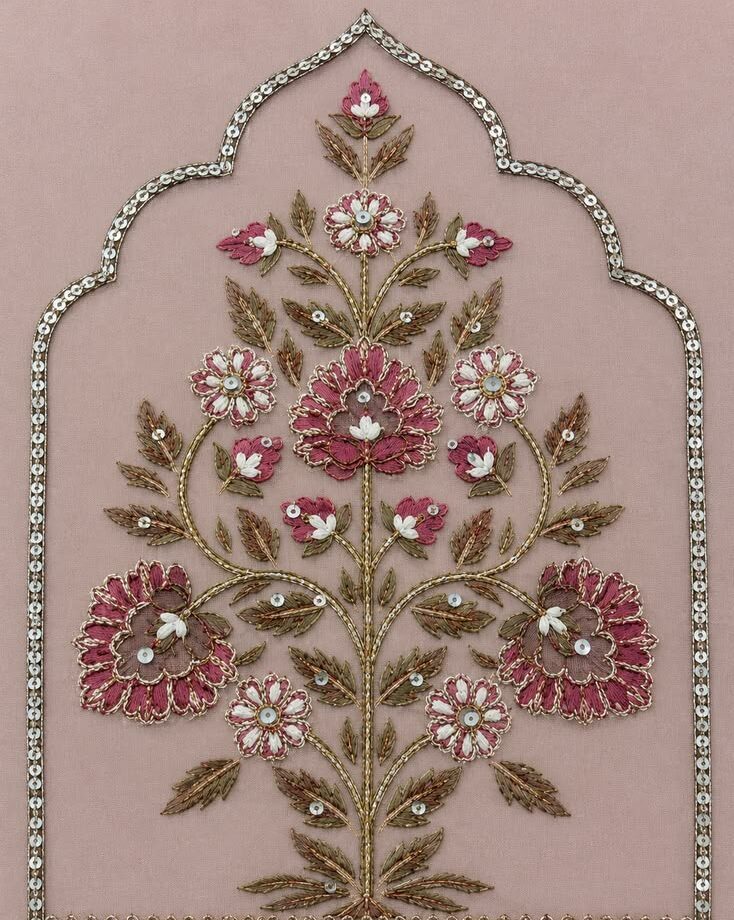
India is a land stitched together — not just by geography or culture, but quite literally by thread.
For thousands of years, Indian artisans have transformed fabric into living canvases, encoding stories, rituals, and regional identity into every stitch.
From the mirror-studded celebrations of Gujarat to the royal sophistication of Lucknow’s chikankari, Indian embroidery is one of the most diverse and breathtaking textile traditions in the world.
A Craft as Old as Civilisation
The roots of Indian embroidery stretch back at least to the Indus Valley Civilisation. Fragments of embroidered cloth have been excavated at sites like Mohenjo-daro, suggesting that the art of decorating fabric was already well-established over 4,000 years ago. By the Mughal era (16th–18th centuries), embroidery had become an imperial obsession — royal ateliers employed thousands of craftspeople who worked on ceremonial garments, court furnishings, and gifts to foreign dignitaries. The word zardozi itself — the art of embroidering with gold and silver threads — became synonymous with Mughal luxury and splendour.
The Major Embroidery Traditions
India’s embroidery styles are as varied as its languages. Each tradition emerged from a specific region, community, and way of life.
1. Chikankari — Lucknow, Uttar Pradesh
Lucknow’s signature craft, chikankari is the art of shadow embroidery on fine white muslin. The name is believed to derive from the Persian word chikan, meaning embroidery. The work is characterised by its delicate, almost translucent quality — stitches are worked from the reverse of the fabric so that a subtle, shadowy pattern appears on the front. There are over 30 distinct stitches in chikankari, with evocative names like phanda (small raised knots), bakhiya (shadow work), and murri (millet-shaped knots).
Once the craft of Nawabi courts, chikankari is today primarily kept alive by Muslim artisan families in Lucknow’s old city. The sector supports an estimated 2.5 lakh artisans, most of them women working from home. In 2008, chikankari received a Geographical Indication (GI) tag — a mark of protected regional identity.
2. Phulkari — Punjab
Phulkari means “flower work” in Punjabi, and the embroidery lives up to its name: vibrant, geometric floral patterns worked in darning stitch on coarse khadi cloth. Traditionally, Punjabi women created phulkari shawls and dupattas over years, often beginning a piece when a daughter was born and completing it in time for her wedding.
Phulkari has two main forms: everyday phulkari with sparse floral motifs, and bagh (garden), where the embroidery covers nearly the entire surface of the fabric in a riot of gold, orange, and red. Today, phulkari is experiencing a revival — appearing on contemporary kurtas, jackets, and even accessories in Indian fashion.
3. Kutchi and Kathiawari Embroidery — Gujarat
Gujarat’s embroidery traditions are among the most visually distinctive in India, defined by their bold geometric patterns and the liberal use of abhla (small mirrors) that catch light and ward off the evil eye. Different communities — the Rabari, Ahir, Banjara, and Jat — each developed their own signature styles.
Kutchi embroidery is typically worked on black or dark-coloured fabric, making the bright reds, oranges, and greens pop dramatically. The stitches are dense and interlocking, often covering the entire surface of skirts (ghagras), blouses (cholis), and household items. This is not just clothing — it is social documentation. Community membership, marital status, and family wealth could all be read from a woman’s embroidered garments.
4. Zardozi — Lucknow, Delhi, Bhopal
Zardozi is the art of heavy metal embroidery using gold and silver threads (zari), sequins, beads, and semi-precious stones on rich fabrics like velvet and silk. The word comes from the Persian zar (gold) and dozi (embroidery). This tradition reached its zenith under the Mughal emperors, who commissioned zardozi work for everything from royal robes to elephant trappings and tent panels.
After a long decline post-Partition, zardozi is now booming again — bridal wear is unthinkable without it. Lucknow and Bareilly remain major centres, and the craft is practiced almost entirely by male Muslim artisans working on karkhanas (workshops), a tradition that goes back centuries.
5. Kantha — West Bengal and Odisha
Kantha is the art of transforming worn-out saris and dhotis into something new and beautiful. Women in Bengal have practiced kantha for centuries, layering old cloth and stitching them together with simple running stitches in patterns that range from geometric borders to complex narrative scenes depicting gods, animals, and daily life.
The word kantha itself refers to the running stitch, and the humble simplicity of that single stitch — worked across densely layered fabric — creates a rippling, wavy texture that is entirely its own. Modern kantha has exploded in popularity, appearing on stoles, sarees, jackets, and quilts, and is now exported globally.
6. Kashmiri Crewelwork and Sozni
Kashmir has two distinct embroidery traditions. Sozni (or sozni kari) is a delicate needle embroidery worked on pashmina and silk shawls, featuring fine floral and paisley motifs that seem almost painted on. A single shawl can take months or even years to complete.
Crewelwork (or Kashida) is bolder — thick wool threads are worked in chain stitch on cotton and linen, creating exuberantly lush floral patterns in jewel-toned colours. Kashmiri crewelwork has long been used for curtains, bedspreads, and upholstery, and remains highly sought after internationally.
The Artisans Behind the Art
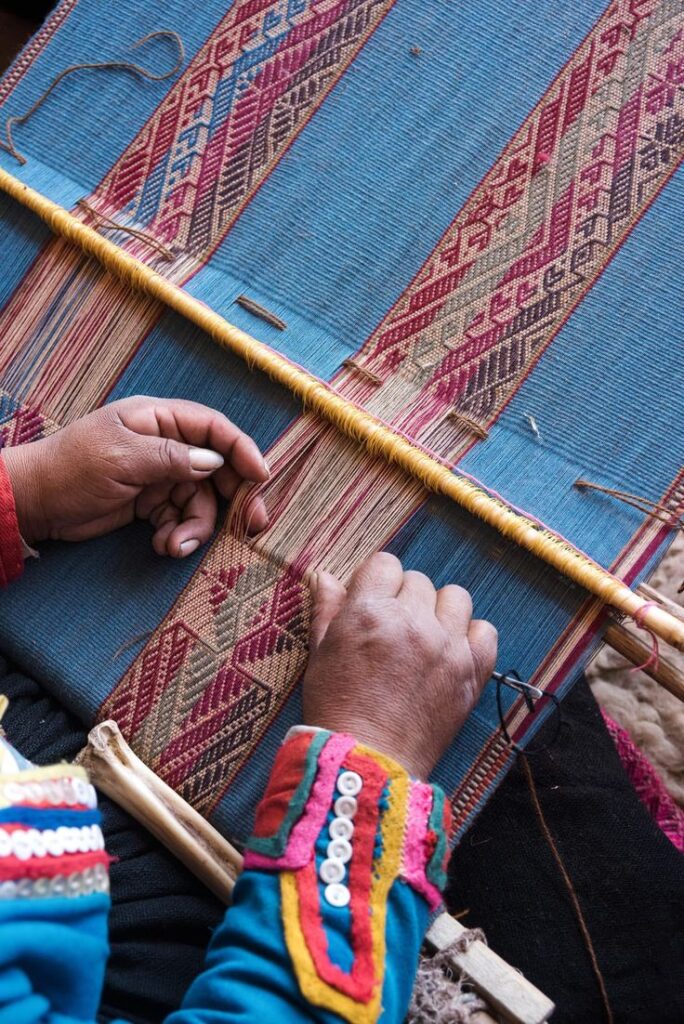
Behind every embroidered piece is a human story — often invisible in the finished product. The majority of India’s embroidery is produced by women working from their homes in rural areas, fitting needlework around household duties and agricultural cycles.
Wages are typically calculated per piece, and can be extremely low — a single chikankari blouse that sells for ₹2,000 in a Lucknow showroom might have earned its maker only ₹50–100.
Organisations like the Self-Employed Women’s Association (SEWA) and various government craft councils have worked to improve conditions and connect artisans directly to markets. Fair-trade labels and direct-to-consumer platforms have made some inroads, but the gap between artisan and consumer remains vast.
How You Can Support Indian Embroidery
- Buy from artisan-direct platforms like Craftsvilla, Okhai, or state-government emporiums (Karnataka Cauvery, UP Handloom, etc.) where a larger share of the price reaches the maker.
- Look for GI-tagged products — chikankari, phulkari, Kutchi embroidery, and Kashmiri sozni all carry GI protection that indicates authenticity.
- Learn the language of the craft. Knowing what kantha or zardozi actually means helps you appreciate — and talk about — what you own.
- Slow down. Real hand embroidery takes time. When you understand how long a piece took to make, the price begins to make sense.
Final Stitch
Indian embroidery is not simply a decorative tradition. It is a record — of communities, beliefs, migrations, and aspirations — written in thread on cloth. Each stitch that a Rabari woman works into a mirror blouse, or a chikankari artisan works into fine muslin, is a link in an unbroken chain of knowledge passed down for generations.
To wear or collect Indian embroidery is to participate in that chain. To learn its names and origins is to honour the hands that made it. And perhaps that is the most important stitch of all — the one that connects us, across distance and difference, to the people who made something beautiful.